


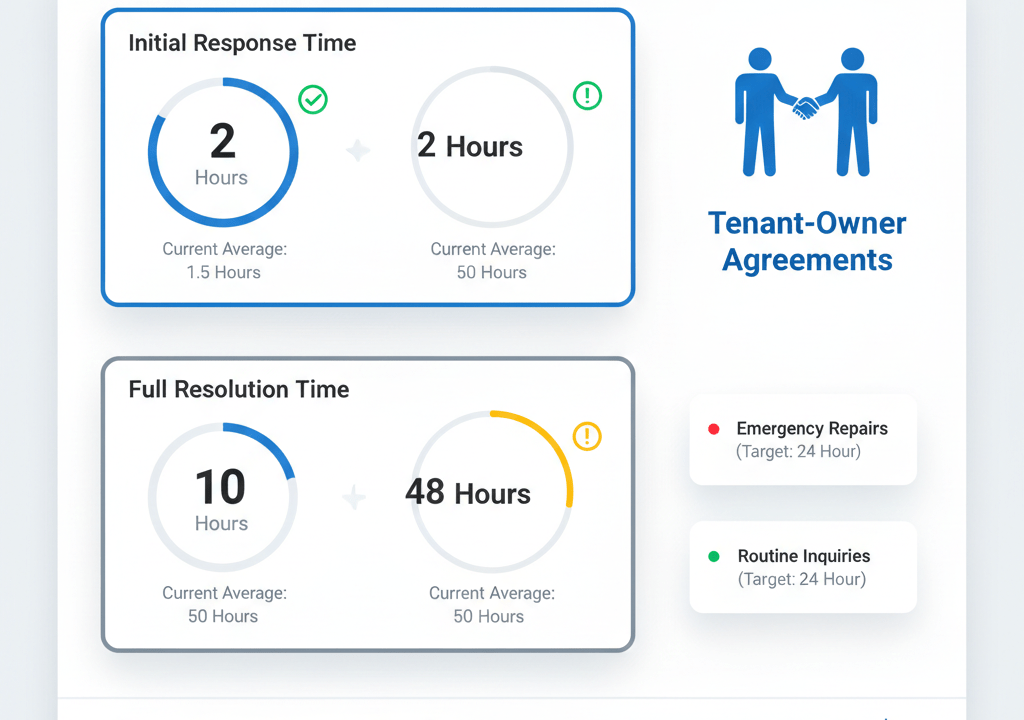
In real estate, “we’ll get back to you soon” is not a standard—it’s a guess. As portfolios grow, vague expectations create frustration for tenants and doubt for owners. Service Level Agreements (SLAs) change that by defining clear, measurable targets for how fast you respond and how quickly you resolve different types of issues.
Good SLAs are not just documents. They are operating rules your team can actually follow—and that tenants and owners can rely on.
Why SLAs Matter in Property Operations
Without SLAs:
- Tenants don’t know whether a reply in 2 hours or 2 days is “normal.”
- Owners can’t easily judge service quality beyond complaints and anecdotes.
- Teams work hard, but still get blamed because expectations were never clear.
SLAs turn service quality into something visible and measurable—so you can manage it, improve it, and communicate it confidently.
Response vs. Resolution: Two Different Promises
A strong SLA separates response time from resolution time:
- Response time – How quickly you acknowledge the issue and let the tenant or owner know you’ve received it.
- Resolution time – How long you aim to take to actually fix the problem or complete the request.
For example:
- “We acknowledge urgent issues within 1 business hour and aim to resolve them within 4–8 hours, where access and parts allow.”
- “We acknowledge non‑urgent requests within 1 business day and aim to resolve them within 3–5 business days.”
This structure sets realistic expectations while still showing seriousness.

Setting Priority Levels That Make Sense
Not all issues are equal. A practical SLA framework uses 3–4 priority levels, such as:
- Priority 1 – Critical
No water, major leak, power failure in common areas, life‑safety issues.
Shortest response and resolution targets. - Priority 2 – High
Issues that affect comfort or security but are not emergencies (e.g., broken AC in summer, malfunctioning access system). - Priority 3 – Standard
Routine maintenance, cosmetic issues, non‑urgent questions. - Priority 4 – Administrative
Document requests, minor information changes, general inquiries.
Defining these levels and sharing examples helps tenants, owners, and staff align on what “urgent” really means.
Making SLAs Operational, Not Just Theoretical
An SLA only works if your systems and processes support it:
- Every request is logged with a timestamp, category, and priority.
- The system tracks when it was first responded to and when it was closed.
- Dashboards show open items by priority and how you are performing against targets.
This allows managers to spot backlog early, reassign work, and have factual conversations about service levels.
Communicating SLAs to Tenants and Owners
Trust comes from clarity and consistency:
- Include SLA expectations in welcome packs, portals, and websites.
- Use simple language and real examples instead of legal jargon.
- Be transparent when you miss a target—acknowledge, explain, and adjust.
Over time, clear SLAs reduce escalations because people know what to expect and see that you take standards seriously.
Reviewing and Improving Over Time
SLAs are not “set and forget.” Review them regularly:
- Are targets realistic for your team size and vendor network?
- Which categories most often fail to meet the SLA—and why?
- As your tools and processes improve, can you tighten standards?
Use real performance data, not just ambition, to adjust.
Standards You Can Stand Behind
Designing SLAs for real estate operations is about making promises you can keep—and then proving that you keep them. When response and resolution times are defined, tracked, and communicated, tenants feel respected, owners feel reassured, and your team has a clear target to organize around.