


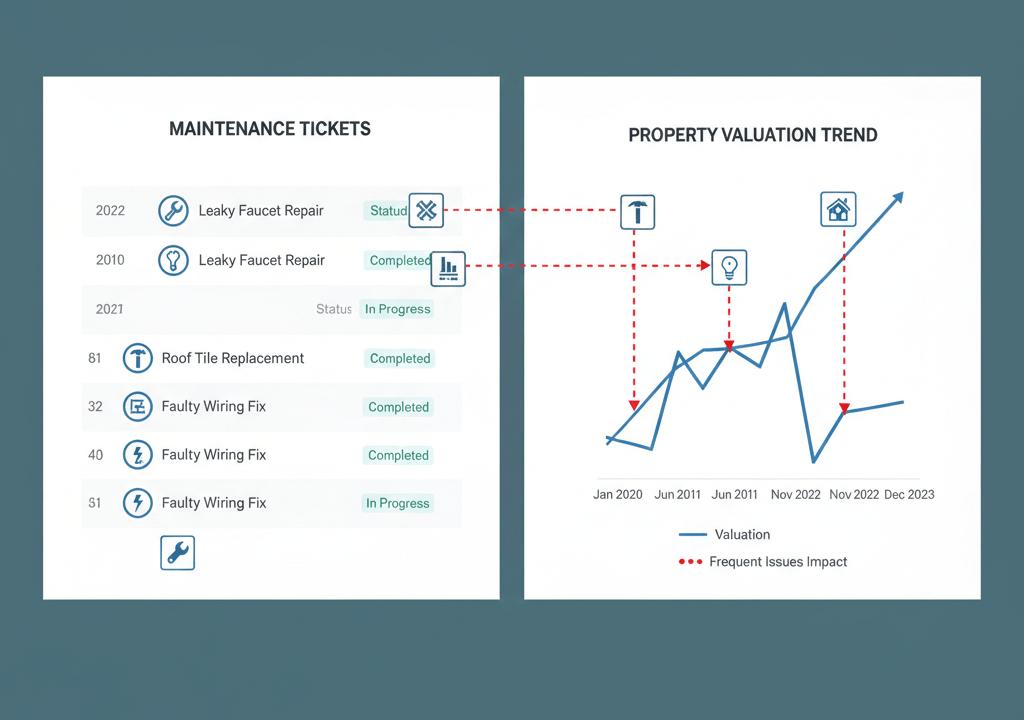
Most maintenance tickets look small on their own: a leak here, a recurring lift error there, a string of “minor” HVAC complaints. Viewed in isolation, they’re just work orders. Viewed as a time series, they’re an early warning system for asset degradation—and a vital input into capex planning and valuation.
Linking maintenance data to asset value is about treating every ticket as a data point in the asset’s health record, not just a task to close.
Why Maintenance Data Belongs in Valuation Conversations
Traditional valuation models focus on income, occupancy, and market comps. Yet two assets with similar rent rolls can perform very differently over time if one is quietly “bleeding” through constant technical issues.
Patterns in maintenance data tell you:
- Which systems are approaching end-of-life.
- Where operating costs are likely to rise.
- How reliable the building is from a tenant’s point of view.
Ignoring that information means underwriting a building’s future on hope rather than evidence.
Turning Tickets into Asset Health Signals
To make maintenance data useful for valuation, you need structure:
- Every ticket is tagged with asset, system (HVAC, elevators, plumbing, facade, etc.), location, and severity.
- Costs (parts, labor, vendor fees) are linked to each work order.
- Repeat issues on the same asset or system are easy to identify.
From there, you can track:
- Frequency of issues by system per building.
- Trend of spend per system over time.
- Downtime or impact on tenants (e.g., lift outages, repeated water cuts).
This transforms a log of “jobs done” into a profile of asset health.

Identifying Capex Triggers from Opex Patterns
Rising operating expense on a system often signals impending capex:
- If elevator repair calls and costs keep climbing, a modernization decision is coming.
- If HVAC tickets spike every summer, replacement or major overhaul may be more efficient than endless patching.
- If water intrusion issues recur in the same stack, the facade or waterproofing may need major work.
By watching thresholds—such as maintenance cost as a percentage of replacement cost, or incident frequency—you can justify capex with hard data instead of gut feel.
Feeding Maintenance Intelligence into Valuation and Strategy
Once maintenance patterns are quantified, they can inform:
- Valuation adjustments – Assets with high, rising maintenance risk may warrant more conservative cap rates or additional capex allowances.
- Hold/sell decisions – Buildings facing major upcoming capex might be candidates for sale—or for strategic reinvestment if the location and income profile support it.
- Lender and investor discussions – Sharing maintenance health data and planned interventions builds confidence that risk is being managed, not ignored.
This makes the link between “small” tickets and “big” financial outcomes explicit.
Practical Steps to Start Linking the Two
- Standardize maintenance logging
Ensure every ticket has asset, system, severity, and cost captured consistently. - Create simple system‑level views
For each building, see issues and spend by system (HVAC, elevators, plumbing, electrical, common areas). - Define capex trigger rules
Examples: “If annual spend on a system exceeds X% of replacement cost for Y years,” or “If incident frequency crosses a defined threshold.” - Integrate into asset reviews
Make maintenance health a standard slide in asset committee and valuation reviews, not an optional appendix.
From “Fix It” to “What Does It Tell Us?”
Every work order is more than a problem to fix; it’s a data point about how your assets are aging. When you connect maintenance data to valuation thinking, you move from reacting to issues to anticipating them—and from guessing capex timing to planning it with evidence.