


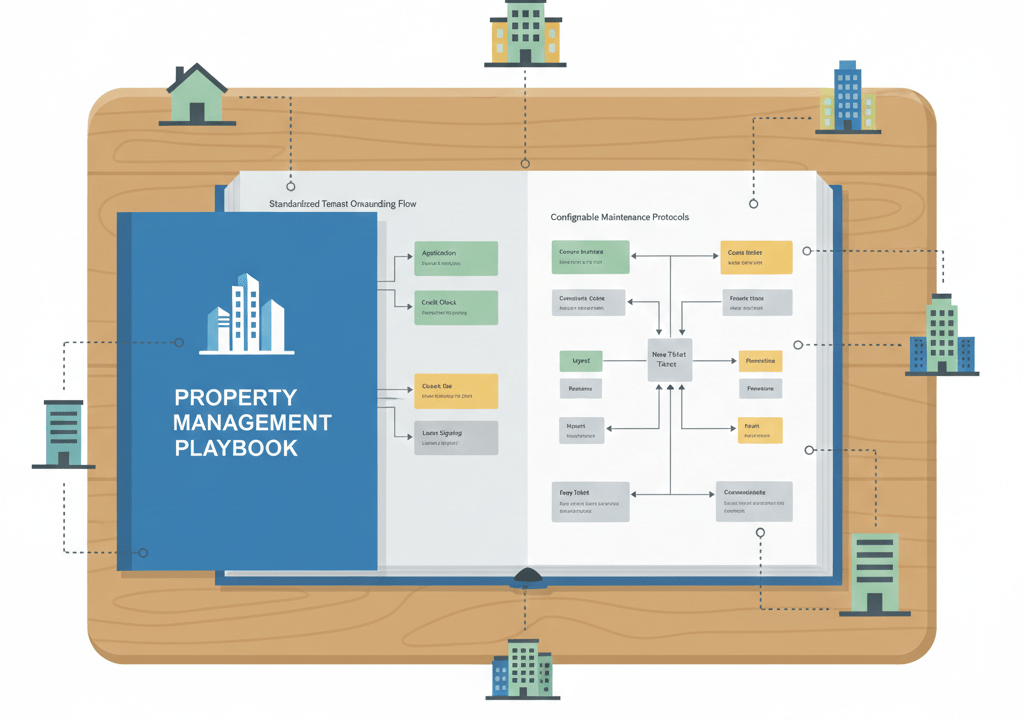
As real estate portfolios expand across cities and countries, each local team naturally creates its own way of doing things. That local creativity is valuable, but without a shared playbook, the organization pays the price: inconsistent service, unpredictable results, and constant relearning. An operating playbook gives you one standard way to run core processes—while still leaving space for local nuance.
The goal isn’t to turn every region into a clone. It’s to agree on what must be consistent and where teams are free to adapt.
Why a Playbook Matters Once You Scale
Without a defined operating playbook:
- Onboarding new buildings or regions takes too long because you “start from scratch” every time.
- Owners and investors see different service levels depending on where their assets sit.
- Best practices stay trapped in individual teams rather than becoming shared standards.
A clear playbook turns successful habits into repeatable, teachable methods.
Decide What Must Be Standard vs. Flexible
A useful playbook makes a deliberate split:
- Standard everywhere
- Definitions (e.g., what “occupied,” “vacant,” or “resolved” means).
- Core workflows (leasing, rent collection, maintenance, complaints handling, renewals).
- Service standards (SLAs for response and resolution, communication tone, escalation paths).
- Data and reporting requirements (what must be recorded, and how).
- Flexible locally
- Channel preferences (e.g., SMS vs. app notifications, local language).
- Vendor choices and local pricing strategies.
- Cultural nuances in communication and community events.
This keeps performance comparable while respecting local realities.

Break the Playbook into Clear Modules
Instead of one giant document, structure your playbook into modules such as:
- Leasing & onboarding
- Rent & revenue collection
- Maintenance & inspections
- Tenant communication & complaints
- Owner reporting
- Compliance & records
- Move‑out & turn‑over
Each module should briefly cover:
- Purpose (what this process exists to achieve).
- Standard steps (a simple flow with 5–10 steps).
- Roles and responsibilities (who does what).
- Minimum data to capture (so reporting stays consistent).
This makes it easier for teams to learn and apply one module at a time.
Make the Playbook Usable, Not Just “Written”
A playbook only works if people actually use it:
- Keep it concise and visual: flows, checklists, and examples instead of dense text.
- Store it in a searchable digital space linked to your actual systems.
- Tie it to training: new hires are onboarded against the playbook, not just shadowing.
- Review it regularly with field feedback, updating when better ways are discovered.
Treat it like a living product, not a one‑off policy PDF.
Let Local Teams Contribute and Localize
To avoid killing flexibility:
- Allow regional “add‑on pages” where teams can document local variations that still respect the core flow.
- Invite local managers to propose improvements that, if successful, can be promoted to global standards.
- Clearly mark which elements are “must follow” and which are “recommended but adaptable.”
This creates ownership instead of resistance.
One Way to Run, Many Ways to Win
A real estate operating playbook doesn’t remove local expertise—it amplifies it. By standardizing the backbone of how you operate, you make results predictable and scalable, while still giving teams room to adapt to their markets. That balance is what lets a multi‑region portfolio behave like one coherent business, not a loose collection of different practices.