


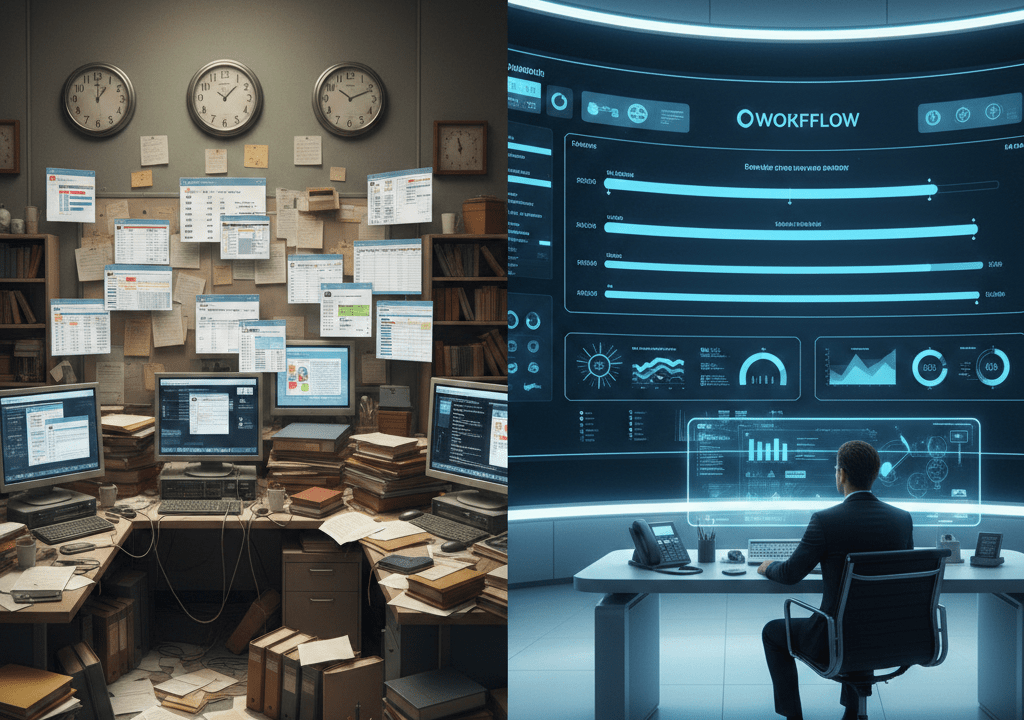
Real estate portfolios are often judged by occupancy, yield, and pipeline—but underneath those numbers sits a quieter force: how fast your organization can move. Operational lag is the delay between when something happens in your portfolio and when your team can see it, understand it, and act. The more fragmented your workflows and systems are, the slower that cycle becomes, and the more value is silently lost.
Portfolio velocity is the opposite: the speed and precision with which your organization can respond to tenants, markets, and investors. This blog looks at how fragmented workflows drag that velocity down—and why treating operations like an integrated system, not a patchwork of tools, is now a strategic requirement.
What Operational Lag Looks Like Day to Day
Operational lag rarely appears as a single crisis. It shows up in:
- Waiting days for updated reports because data lives in different systems and spreadsheets.
- Approvals and decisions stuck in email threads or chat messages.
- Maintenance tickets that bounce between tools before reaching the right person.
- Sales, finance, and operations teams working from different “versions” of the truth.
None of these delays are dramatic on their own. Together, they slow everything: pricing decisions, capex planning, leasing strategy, tenant resolutions, and investor communication.
Fragmented Workflows: The Hidden Brake on Performance
Most of this lag comes from fragmentation:
- One system for leasing, another for maintenance, another for payments, another for reporting.
- Manual bridges—spreadsheets, exports, and copy‑paste—to move information between them.
- Human “routers” whose job is to translate and re-enter data for different teams.
Every handoff adds friction and risk. By the time data reaches leadership, it is often already out of date. That makes it harder to act with confidence, so decisions are postponed, and opportunities slip by.
Defining Portfolio Velocity
Portfolio velocity is your ability to:
- See what’s happening in near real time (occupancy, arrears, incidents, demand).
- Decide quickly (adjust pricing, approve capex, reassign budget, change strategy).
- Execute consistently (push actions back into daily workflows without chaos).
High portfolio velocity doesn’t mean rushing. It means your organization can move fast when it needs to—because the information is clear and the workflows are connected.
How to Measure the Cost of Operational Lag
You can’t manage what you don’t measure. A few simple indicators highlight how much lag is costing you:
- Cycle time for key decisions
How long from “we see a problem” to “we implement a response”? For example, noticing a spike in arrears vs. adjusting policies or outreach. - Time to close books and produce a clean report
If it takes weeks of reconciliation, that delay is a cost on every strategic decision tied to financials. - Average ticket resolution time for tenants and vendors
Slow resolutions hurt satisfaction, increase churn, and raise your vendor and maintenance costs. - Frequency of manual workarounds
Every ad‑hoc spreadsheet, side database, or offline process is a sign your system is too slow to keep up.
Translating these into money (extra staff hours, lost pricing opportunities, higher vacancy, higher risk) makes the true cost visible.

Moving from Fragmented Tools to a Single Operating System
To improve portfolio velocity, you don’t just “add another tool”—you redesign how work flows:
- Map your critical workflows
Focus on a few that matter most: rent collection, maintenance, leasing, reporting. - Identify every handoff and system involved
Note where people export, email, or manually re-enter information. - Consolidate onto a shared backbone
Use one operating system that can handle the full lifecycle of each workflow, or integrate tightly so data doesn’t need to be rebuilt at every step. - Automate routine transitions
Examples: ticket creation from tenant requests, status updates driving notifications, payments updating ledgers automatically. - Make performance visible in real time
Dashboards should reflect the current state, not last month’s state, so decisions can keep up with reality.
As workflows become continuous instead of stitched together, operational lag shrinks and portfolio velocity rises.
Speed as a Competitive Advantage
In today’s market, owning good assets is not enough. Two portfolios with similar buildings can perform very differently depending on how fast their organizations can see issues, make decisions, and execute. Fragmented workflows quietly cap that speed.
Treating your operations as a single, connected system turns portfolio velocity into a concrete advantage. When lag disappears, you don’t just move faster—you make better decisions, at the right time, with fewer surprises.