


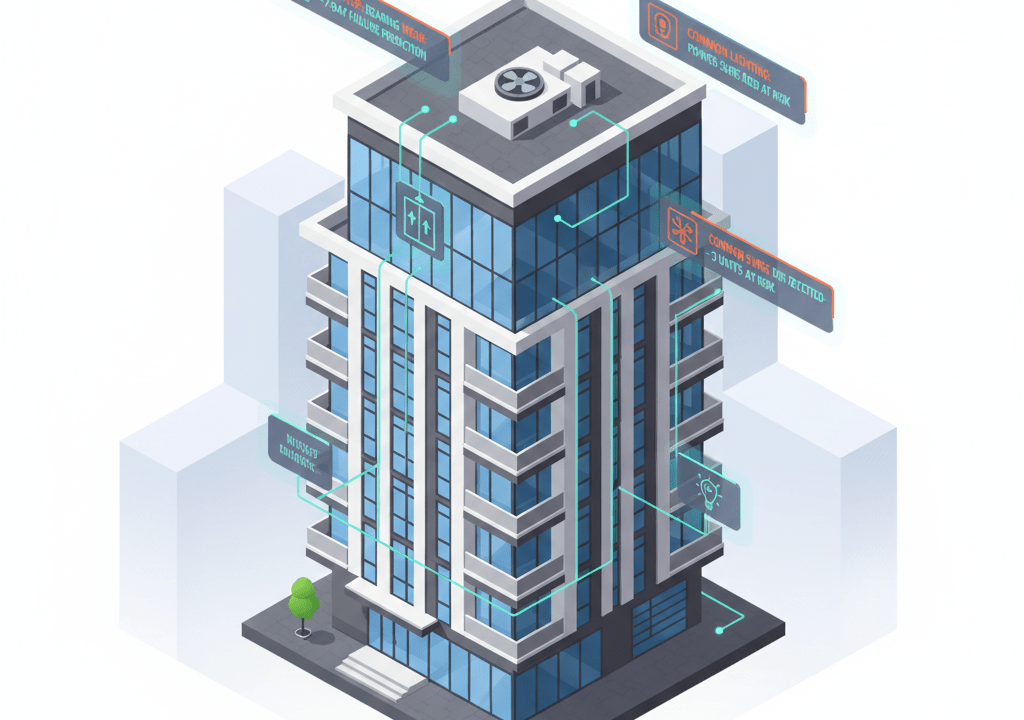
Most buildings don’t suddenly fail; they slowly degrade. The problem is that traditional maintenance models only react once something is visibly broken or tenants start complaining. By then, the damage to resident trust and asset value has already begun. Predictive maintenance uses data and automation to flip that script shifting from “fix when it fails” to “intervene before it breaks,” protecting both cash flow and long‑term equity.
For owners, investors, and property managers, this isn’t just a technical upgrade. It is a direct lever on NOI, capex planning, and the lifetime performance of every asset in the portfolio.
From Reactive Repairs to Predictive Insight
Reactive maintenance waits for incidents: a chiller fails, an elevator stops, a leak appears in a high value unit. Each event is urgent, disruptive, and expensive. Planned preventive maintenance improves this by following a schedule, but it still doesn’t respond to the actual condition or usage of equipment.
Predictive maintenance adds the missing layer: data. Sensor readings, usage hours, fault logs, work-order histories, and environmental conditions are combined to spot patterns that indicate emerging issues. Instead of guessing when to intervene, the system surfaces early risk signals so teams can act at the optimal moment before failure, but without wasting budget on unnecessary checks.
Why Predictive Maintenance Protects Equity
Every major system in a building HVAC, elevators, pumps, access control, life safety directly influences asset performance:
- Financially, unexpected breakdowns cause unplanned capex, rent concessions, and operational downtime.
- Operationally, they strain staff, overload vendors, and divert attention from higher-value work.
- Reputationally, they damage tenant experience, increasing churn and reducing pricing power.
By catching issues early, predictive maintenance extends the useful life of equipment, smooths capex curves, and reduces the frequency of disruptive failures. Over time, this stabilizes operating costs and supports higher valuations.
What a Predictive Maintenance Stack Looks Like
A practical predictive maintenance setup in PropTech typically includes:
- Unified asset registry
Every critical asset (by building, system, and component) is tracked in one system with age, specs, and service history. - Data collection layer
IoT sensors where appropriate (temperature, vibration, energy use) combined with digital work-order and incident logs. - Rules and models
Thresholds, trend detection, and, over time, machine-learning models that flag abnormal patterns or high-risk assets. - Actionable workflows
When a risk condition is met, the system automatically creates and routes a targeted work order, with priority and context.
The key is that data does not sit in isolation; it flows directly into operational workflows your teams already use.

Getting Started Without Overcomplicating It
You do not need a fully sensorized smart building to benefit from predictive maintenance. A pragmatic approach:
- Identify your top failure-prone systems
Focus first on HVAC, elevators, pumps, or critical systems that impact many residents at once. - Digitize maintenance history and work orders
Move existing logs out of paper and spreadsheets into a single system so you can see patterns over time. - Define simple risk rules
Examples: “More than 3 incidents on the same asset in 90 days,” or “Energy consumption deviates 20% from baseline.” - Automate next steps
When a rule is triggered, automatically generate a work order, notify the right vendor, and track resolution time. - Iterate into more advanced analytics
As data accumulates, refine rules, add sensors where ROI is clear, and gradually move toward more sophisticated models.
Turning Maintenance into a Strategic Function
When maintenance is purely reactive, it is perceived as a cost center. When it is predictive and data led, it becomes a strategic function:
- Capex becomes planned, not panicked.
- Tenant trust improves because major disruptions are rarer.
- Assets hold their performance profile longer, supporting stronger valuations.
Predictive maintenance is not about chasing buzzwords; it is about using the data your portfolio already produces to protect equity, stabilize cash flow, and keep each asset performing at its designed potential.