


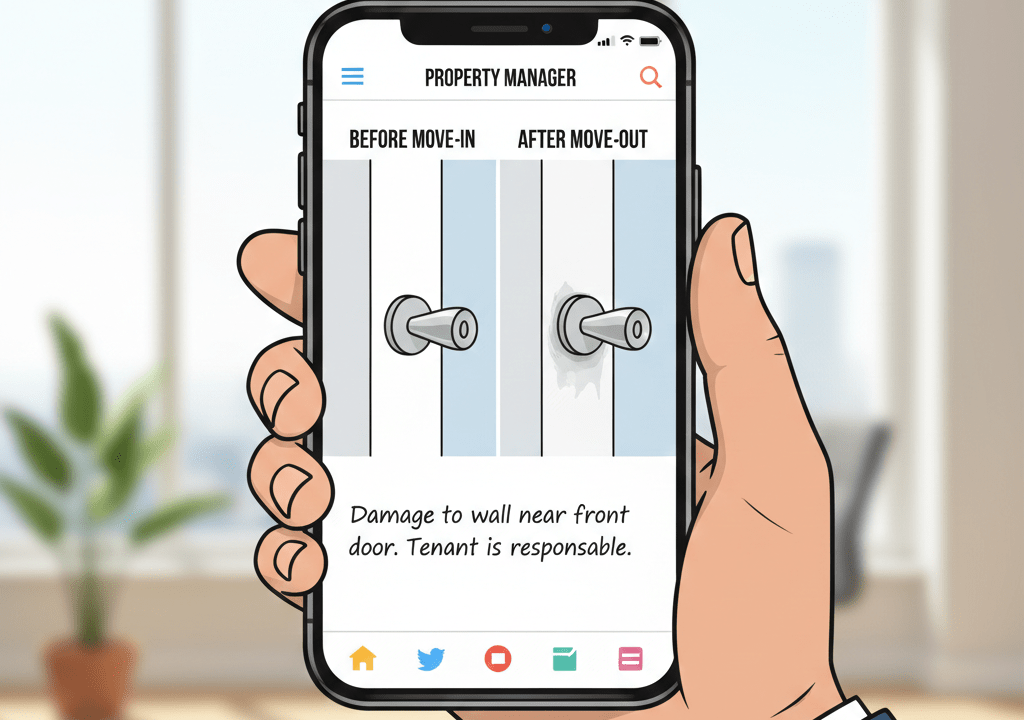
Most arguments don’t start because people are dishonest—they start because people remember things differently.
- Tenants may genuinely believe damage was already there.
- Owners may assume anything wrong must be “beyond wear and tear.”
- Property managers often weren’t standing there on day one.
Without proof, every conversation feels personal instead of practical.
How Photos Help Tell the Story
Good photos show what words can’t.
- Take photos at move‑in of each room, key surfaces, and any existing marks or damage.
- Repeat at move‑out, capturing the same angles and any new issues.
- Include close‑ups of problem areas (stains, cracks, broken items, bad cleaning).
When you can show a “before” and “after” image, the question “who broke what?” becomes much easier to answer calmly.
Why Simple Notes Matter Just as Much
Photos are powerful, but short, clear notes make them even stronger.
- Use a simple checklist: walls, floors, doors, windows, appliances, bathroom, balcony, etc.
- Mark each as “ok,” “worn,” or “damaged,” with a short comment where needed.
- Mention anything agreed verbally (e.g., “small wall scuffs present at move‑in, no charge”).
These notes explain the context behind the photos so no one has to guess what they mean later.
Making Proof Easy to Find
Proof only works if you can find it quickly when someone questions a charge.
- Store photos and notes in the same place as the lease or unit record.
- Label them clearly by date and inspection type: “Unit 304 – Move‑In – Jan 2026.”
- Avoid keeping photos only in personal phones or random chats.
When a tenant or owner asks a question, you can pull up the record in seconds instead of searching through old folders and messages.
How This Changes Difficult Conversations
With clear notes and photos:
- You can calmly show: “Here’s what it looked like when you moved in, and here’s how it looks now.”
- Tenants are more likely to accept fair charges when they see the difference.
- Owners see that you’re protecting their property without guessing or over‑charging.
The focus shifts from blame to facts, which protects relationships and your reputation.