


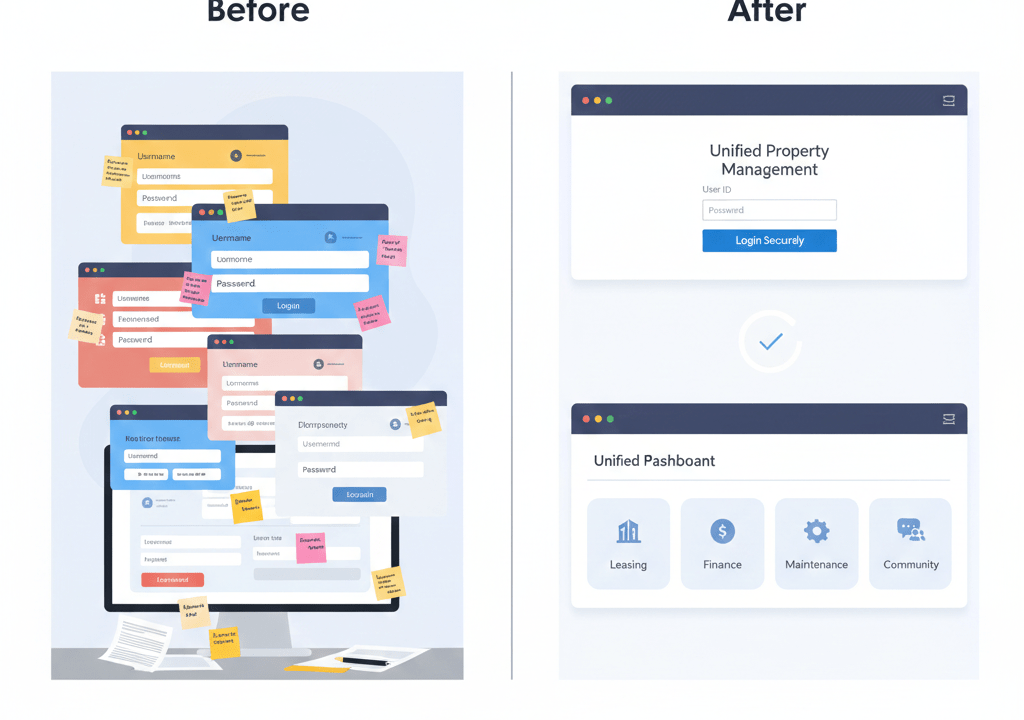
Most property teams juggle multiple systems every day: one for leases, another for maintenance, a third for payments, plus email and chat on top. Each tool has its own login, layout, and way of storing data. It works—until it doesn’t. People start forgetting passwords, information gets duplicated, and simple tasks require jumping between screens.
Moving to one login for a unified platform doesn’t just feel tidier. It makes daily work faster, reduces mistakes, and keeps everyone operating from the same reality.
The Hidden Cost of Too Many Logins
Multiple tools create friction your team feels every day:
- Time lost switching between apps just to complete one task.
- Password fatigue and lockouts that slow work down.
- New staff needing long training just to understand “which system to use for what.”
The more scattered the tools, the easier it is for tasks, messages, or updates to fall through the cracks.
What One Login Actually Changes
With a single login into a unified property platform, your team can:
- See leases, tenants, units, tasks, and payments in one place.
- Move from a tenant message to their lease, balance, and maintenance history in a few clicks.
- Work from shared dashboards instead of exporting and emailing files around.
Instead of stitching information together across tools, people stay in one environment and let the system connect the dots.

Better Collaboration, Fewer “Who Did What?” Moments
When everyone works inside the same platform:
- Notes, actions, and updates are visible to the whole team.
- You can see who responded to a tenant and what was promised.
- Handovers between team members are smoother because context is built into the system.
This reduces duplicated effort and awkward miscommunications with tenants and owners.
Easier Onboarding and Lower Risk
One login also simplifies onboarding and security:
- New hires learn one main system instead of five unrelated ones.
- Access can be tailored by role (leasing, finance, maintenance, management) inside the same platform.
- When someone leaves, disabling one account revokes access across the board.
That makes the operation safer and less dependent on “who remembers which login.”
One Door, Many Rooms
Think of one login as a single front door into all the “rooms” your team needs—leasing, finance, maintenance, communication—without needing a separate key each time. When daily work happens in one connected place, operations feel calmer, mistakes drop, and your team finally gets to focus on managing properties instead of managing software.