


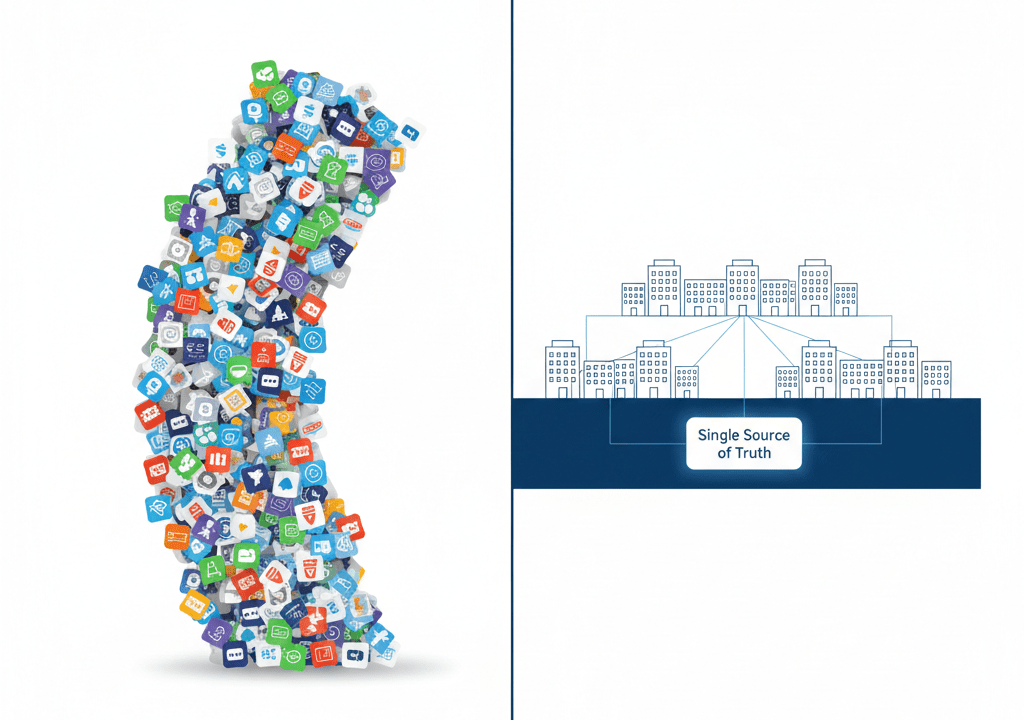
Many property businesses grow their tech the way they grow their team—one hire, one tool at a time. A leasing app here, a maintenance system there, a finance tool later. It works at a few hundred units. Then, somewhere between 2,000 and 10,000 units, the stack starts to creak: integrations break, data conflicts, reporting slows, and every new building feels harder to bring online than the last.
The difference between a stack that stalls and one that scales is simple: point solutions versus platforms. Point solutions solve isolated problems. Platforms provide a shared foundation you can keep building on.
When Point Solutions Start to Fail at Scale
Point solutions feel efficient early on: fast setup, a narrow feature set, and a clear use case. As your portfolio scales, problems emerge:
- Each team chooses its own “best tool,” creating silos for leasing, maintenance, payments, and community.
- Data structures differ across tools, so the same unit or tenant looks different in each system.
- Integrations are custom, fragile, and expensive to maintain.
At 10,000+ units, this turns into constant firefighting: reconciling numbers, fixing broken syncs, and manually connecting workflows that should be automatic.

What Makes a Platform Different
A platform is not just a “bigger tool.” It’s a foundation with three key characteristics:
- Shared data model – Units, leases, tenants, and financials are represented once and reused across modules.
- Modular capabilities – Leasing, payments, maintenance, documents, and community are separate features that plug into the same core.
- Extensibility – APIs and configuration options let you add new use cases without breaking the old ones.
This means you can grow from hundreds to tens of thousands of units by adding modules and automations—not by replacing everything every few years.
Signs Your Stack Needs to Move to a Platform
You’re likely hitting the ceiling of a point-solution stack if:
- Every new project requires “special” integration or a custom spreadsheet.
- Different reports for the same metric (like occupancy or arrears) don’t match.
- IT spends more time maintaining connectors than improving workflows.
- Onboarding a new region or asset class feels like starting from zero.
These are less about “user error” and more about structural limits.
Designing a Platform-Ready PropTech Stack
To build a stack that can survive 10,000+ units and beyond:
- Choose a system of record for core entities
Decide where units, leases, tenants, and financial transactions “live” and make everything else reference that source, not the other way around. - Prioritize platforms with native breadth
Look for solutions that support multiple workflows (leasing, billing, maintenance, communication) in one environment, rather than stitching five niche tools together. - Use integrations to extend, not to glue basics
Integrate for specialized functions (e.g., marketing, advanced analytics), not to make up for missing fundamentals like lease management or rent collection. - Standardize interfaces and APIs
Ensure your main platform exposes clear, stable APIs so future tools can plug in without complex rework. - Design for onboarding at scale
New buildings or portfolios should be onboarded through repeatable templates, not one-off projects.
The Payoff: Stability, Speed, and Lower Total Cost
A platform approach brings three major benefits at scale:
- Stability – Fewer moving parts, fewer breakpoints, and less reliance on brittle custom integrations.
- Speed – Faster launches of new projects and markets, because the foundation is already in place.
- Lower total cost – Less spend on integration maintenance, fewer duplicate tools, and more productive teams.
Instead of constantly patching together a stack that wasn’t meant to handle 10,000+ units, you invest once in a backbone designed to carry that weight.