


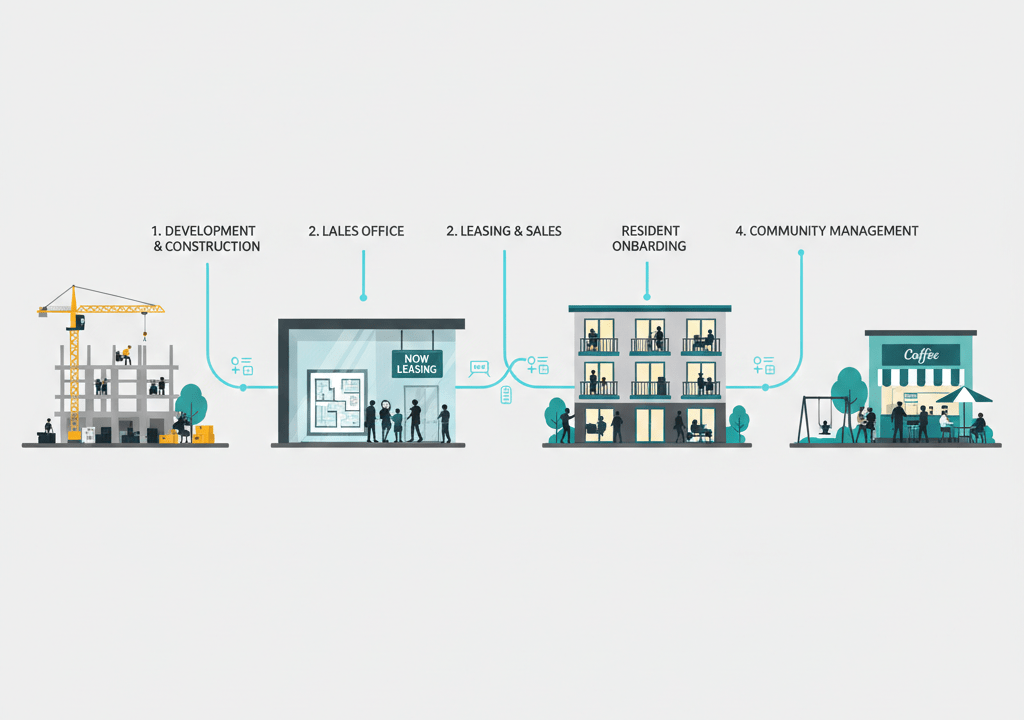
Most real estate technology is built around one stage of the lifecycle: either project sales, or property management, or community engagement. In reality, value is created (or destroyed) across the entire journey—from the first plot of land acquired to the day a mature community renews its leases. When each phase runs on different tools, data fractures, teams duplicate work, and leadership never sees a clean, continuous picture of performance.
A single operating system approach connects every stage—build, sell, manage, and engage—on one continuous digital backbone. Instead of restarting from zero at each phase, you carry structured intelligence forward, compounding value over time.
Why the Lifecycle Breaks in Silos
In a typical portfolio, each stage tends to choose its own software:
- Development teams use project and cost tools for greenfield projects.
- Sales and marketing adopt separate CRM and booking systems.
- Property managers work in another platform for leases and operations.
- Communities rely on yet another app, group, or channel for resident engagement.
Every handover—construction to sales, sales to management, management to community—requires reconstruction of data. Unit details, pricing history, buyer or tenant information, and documents are re-entered or reformatted. This slows launches, clouds accountability, and increases the risk of errors.
What a Single Operating System Looks Like
A real estate operating system treats the entire lifecycle as one workflow with shared entities—units, people, contracts, tasks, documents, and financial flows. The stages change, but the core record remains the same.
- Build
Units are defined as structured inventory from day one: types, attributes, pricing logic, and availability rules. Project costs and timelines sit alongside this inventory. - Sell
Listings, reservations, down payments, and sales contracts operate directly on that same inventory—no separate shadow database. Sales performance feeds back into development and investment views. - Manage
Once occupied, units transition from “stock” to “managed assets” without data loss. Lease terms, billing schedules, maintenance responsibilities, and vendor tasks attach to the same unit records. - Engage
Tenant and community interactions—onboarding, support requests, announcements, access control, and forums—are all linked to the same units and profiles, not a separate community system.
The result is a single, evolving dataset instead of four different systems trying to describe the same reality.
How This Protects Value at Each Stage
- During build: Better launch planning, accurate unit definitions, and cleaner handover to sales.
- During sales: Real-time visibility into inventory, pricing tiers, and absorption, improving strategy and cash flow timing.
- During management: Faster go-live on new projects, fewer setup errors, and a direct line between original specifications and operational needs.
- During community engagement: Richer context for every interaction, stronger resident experience, and a more stable revenue base.
Over time, leadership gains a longitudinal view: how decisions made at the greenfield stage affect sales velocity, operating costs, and long-term resident satisfaction years later.

A Practical Path to a Unified Lifecycle
You don’t have to rebuild everything at once. A realistic sequence:
- Start with unified unit inventory
Agree that units and spaces live in one shared model from development through to operation. - Connect sales to that inventory
Replace standalone sales spreadsheets and CRMs that duplicate unit data. Ensure every reservation and sale updates the shared inventory in real time. - Standardize the transition to management
Define a digital “handover package” so new buildings and phases move into operations without re-creation of leases, pricing, and documents. - Layer community tools on top of the same records
Use engagement tools that reference the same tenant and unit identities used in management, so communication and access control remain consistent. - Continuously feed insights back to the start
Use performance data from management and community (churn, maintenance costs, satisfaction, pricing response) to inform future development and sales strategy.
One Workflow, Compounding Intelligence
Real estate portfolios that treat each lifecycle stage as a standalone project leave intelligence on the table. By designing a single operating system for build, sell, manage, and engage, you convert once-fragmented processes into one compounding workflow. Data captured at the earliest stages remains useful years later, and every new community becomes sharper, faster, and more valuable than the last.