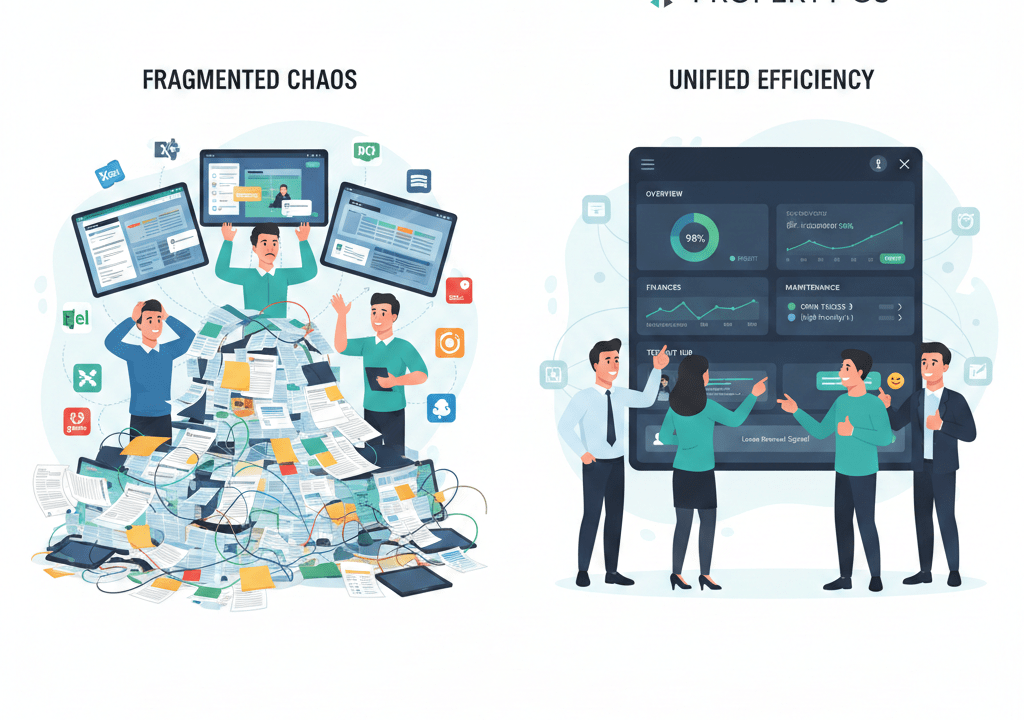


In most real estate organizations, the tech stack doesn’t break in obvious ways. Deals still close, rent still comes in, reports still go out. But behind that surface, a quiet drag on performance is at work: the fragmentation penalty. Disconnected tools, spreadsheets, and manual bridges between systems slowly erode portfolio value without ever appearing as a single line item on the P&L.
For asset managers, institutional investors, and enterprise property managers, this is not a minor IT inconvenience. It is a structural risk to yield, liquidity, and reputation. Understanding the fragmentation penalty is the first step toward designing a real estate operating system that actually protects and grows equity.
What Is the “Fragmentation Penalty”?
How Fragmented Tools Look in Real Life
A typical portfolio runs on a patchwork of systems: one platform for leasing, another for accounting, a separate ticketing tool for maintenance, a standalone CRM for leads, and shared spreadsheets to connect everything that doesn’t quite fit together. Each team has its own “truth,” and alignment depends on meetings and manual exports.
On the ground, this means property staff re-enter the same tenant details in multiple places, finance teams reconcile numbers from three systems, and asset managers constantly ask for “final versions” of reports. None of these steps directly adds value, but all are required just to keep the machine running.
The Hidden Costs You Don’t See on the P&L
Because there is no single moment of “failure,” the fragmentation penalty hides in delay and confusion. Decisions are made on data that is already outdated by the time it is compiled. Conflicting spreadsheets weaken stakeholder confidence in the numbers. Opportunities to adjust pricing, renew key tenants, or time asset exits are missed because the signals arrive too late.
The result is a silent tax on the portfolio: more staff time, more errors, slower action, and a constant drag on asset performance.
Where Portfolio Value Gets Destroyed
Operational Lag and Slower Asset Decisions
When data is scattered across tools, even simple strategic questions take days or weeks to answer. Should we adjust pricing on a specific block of units? Is this asset underperforming relative to the rest of the portfolio? Which buildings carry the highest maintenance risk this quarter? If the organization needs to pull data from multiple systems and spreadsheets to find out, decisions inevitably lag market conditions.
This operational lag translates directly into weaker NOI, mistimed capital expenditures, and slower reaction to market shifts. In a competitive environment, that delay is a structural disadvantage.
Financial Leakage and Reconciliation Overhead
Fragmentation also shows up in finance. Multiple bank accounts, disconnected payment systems, and manual billing workflows create room for missed charges, double entries, and misapplied payments. Every month-end close becomes a mini-project of reconciliation, consuming high-value time from finance and operations.
Even when the books are technically correct, the cost of achieving that accuracy—repeated checks, manual corrections, back-and-forth between departments—reduces the net efficiency of the portfolio.
Tenant Experience and Churn
From the tenant’s perspective, fragmentation appears as inconsistency. A maintenance issue logged in one system might not be visible to the team responsible for follow-up. A payment processed in one tool may not immediately reflect in another, triggering unnecessary reminders or confusion. Communication channels are scattered across SMS, email, and portal messages without a single coherent thread.
When small frictions accumulate, residents lose trust. Turnover rises, and the lifetime value of each tenant falls. The portfolio quietly pays for fragmented systems in the form of higher vacancy and more frequent re-leasing cycles.
Compliance and Audit Risk
Finally, fragmented records create compliance risk. Lease files, KYC documents, payment proofs, and board approvals often live in different silos—email attachments, local drives, unstructured cloud folders, and line-of-business systems that don’t talk to each other. In the event of an audit, dispute, or regulatory inquiry, reconstructing a defensible history is slow and stressful.
Even if the organization “passes,” the time wasted and the risk carried are higher than they need to be, simply because there is no unified, audit-ready repository of truth.
Diagnosing Fragmentation in Your Portfolio
Quick Self-Assessment Checklist
A simple set of questions can reveal whether your organization is paying the fragmentation penalty:
- How many different systems store core property data (units, leases, tenants, payments)?
- How often is the same information re-entered in more than one place?
- How long does it take to produce a portfolio-wide view of occupancy, arrears, and key risks you actually trust?
- How many spreadsheets are acting as glue between “official” systems?
- How dependent are you on a few key individuals who know how to reconcile everything?
If the honest answers are uncomfortable, the penalty is already active.
Red Flags That Your Operating System Is Missing
Certain patterns almost always indicate that a true operating system is absent:
- Spreadsheets are the primary tool for cross-portfolio views.
- Staff build side-tracking tools because official systems “can’t do it.”
- Leadership regularly hears, “We can get you that report—just not today.”
These are not just workflow quirks; they are symptoms of a structural gap.
The Case for a Single Operating System
From Disparate Toolkits to Unified Logic
A real estate operating system replaces disconnected tools and manual links with a single, integrated backbone. Instead of each department choosing its own application and improvising connections, the core data model is shared: units, leases, people, tasks, documents, and financial flows all live within one continuous environment.
Processes build, list, sell, allocate, manage, maintain, engage, and report run on this shared layer. Every transaction and interaction updates the same underlying record, reducing duplication and confusion.
What Changes When Everything Is Connected
Once information moves in real time through a unified system, the organization’s posture changes:
- Asset managers see up-to-date occupancy, arrears, and pipeline views without waiting for manual consolidation.
- Finance can close books faster with fewer reconciliation surprises, because operational and financial events are already aligned.
- Property teams respond to tenants with full context, improving trust and retention.
- Compliance teams can generate audit-ready histories with minimal effort.
In other words, the operating system converts the invisible fragmentation penalty into visible, measurable gains.
A Simple Framework to Start Defragmenting
You do not have to replace everything at once. A structured, phased approach makes the transition manageable:
- Map your current stack
Document every system, spreadsheet, and manual process that touches core data—units, leases, tenants, payments, maintenance, and documents. - Highlight duplication and manual bridges
Mark where people copy-paste, export/import, or re-key information between tools. These are the fault lines where value is leaking. - Choose three critical workflows to fix first
Common starting points are rent collection, maintenance, and reporting. Define what “one continuous workflow” would look like for each, from trigger to outcome. - Design your future-state operating model
Decide which data and processes must be centralized, which can remain specialized, and which tools should be retired or integrated. - Pilot on a contained scope
Start with one region, building type, or portfolio slice. Prove that a unified approach reduces effort and accelerates decisions, then scale.
Stop Paying the Silent Tax
The fragmentation penalty rarely announces itself with a single catastrophic event. It erodes value quietly through delays, duplicated effort, avoidable errors, and lost opportunities. For serious owners, investors, and managers, accepting this as “just how things are” is no longer an option.
Treat your technology stack as an operating system, not a toolbox. Once data, workflows, and teams run on a single continuous backbone, the silent tax disappears—and the full performance potential of your portfolio comes into view.

Review Title
There are many variations of passages of Lorem Ipsum available, but the majority have suffered alteration in some form, by injected humour, or randomised words which don't look even slightly believable. If you are going to use a passage of Lorem Ipsum, you need to be sure there isn't anything embarrassing hidden in the middle of text.
8.1
If you use this site regularly and would like to help keep the site on the Internet, please consider donating a small sum to help pay for the hosting and bandwidth bill. There is no minimum donation, any sum is appreciated - click here to donate using PayPal. Thank you for your support.
Pros
- Pros Item One
- Pros Item Two
- Pros Item Three
- Pros Item Four
- Pros Item Five
Cons
- Cons Item One
- Cons Item Two
- Cons Item Three
- Cons Item Four
- Cons Item Five